The Lake Was Gone
The Anàphora Script
It had been a long and unexpected journey. Liri has finally decided to rest.
He wears a beige tunic, something like a monastic habit cut in a contemporary way, covering his entire body and leaving only his arms bare. He now finds himself in a small room, a square refuge with dark earth-colored walls. The floor is a simple monochrome surface almost entirely covered with overlapping Persian rugs in shades of red and brown. The room is dark; there is little light except for a small window that lets in a late-afternoon beam of sunlight that cuts through the space like a Caravaggio painting.
He turns on the light.
The first thing to do now is to sit. Three simple planks of dark wood fit perfectly together to form a small chair. The stool appears light yet solid; in profile the wood seems almost ready to bend, were it not for two small iron bars that, once screwed in place, support the whole structure.
Liri has three more wooden planks, larger this time. Two of them are taller and longer; he arranges them in an X to form a cross. On top of it he places a flat board cut into a circle and fits it in place, creating a table.
Now he can sit and contemplate the room.
He looks at the window and sees a small reflection on one of the walls, greenish like what lies outside.
He stands up and, after so much traveling, admires himself in a small mirror. It is composed of a central reflective panel and two side wings, imitating the window opposite.
Liri now has a beard and sun-tanned skin.
As he looks at himself, he remembers the day he left, when there were still no hairs on his face and his skin was constantly burned by the sun.
On the lake he would go out every day in his boat with his father to fish, both by day and by night, in sun and rain.
They would cast the nets—which he was responsible for mending periodically—rowing out until they reached a place where the lake was deep enough. There they would throw the net and catch a few small fish for lunch; the rest they sold in the nearby villages.
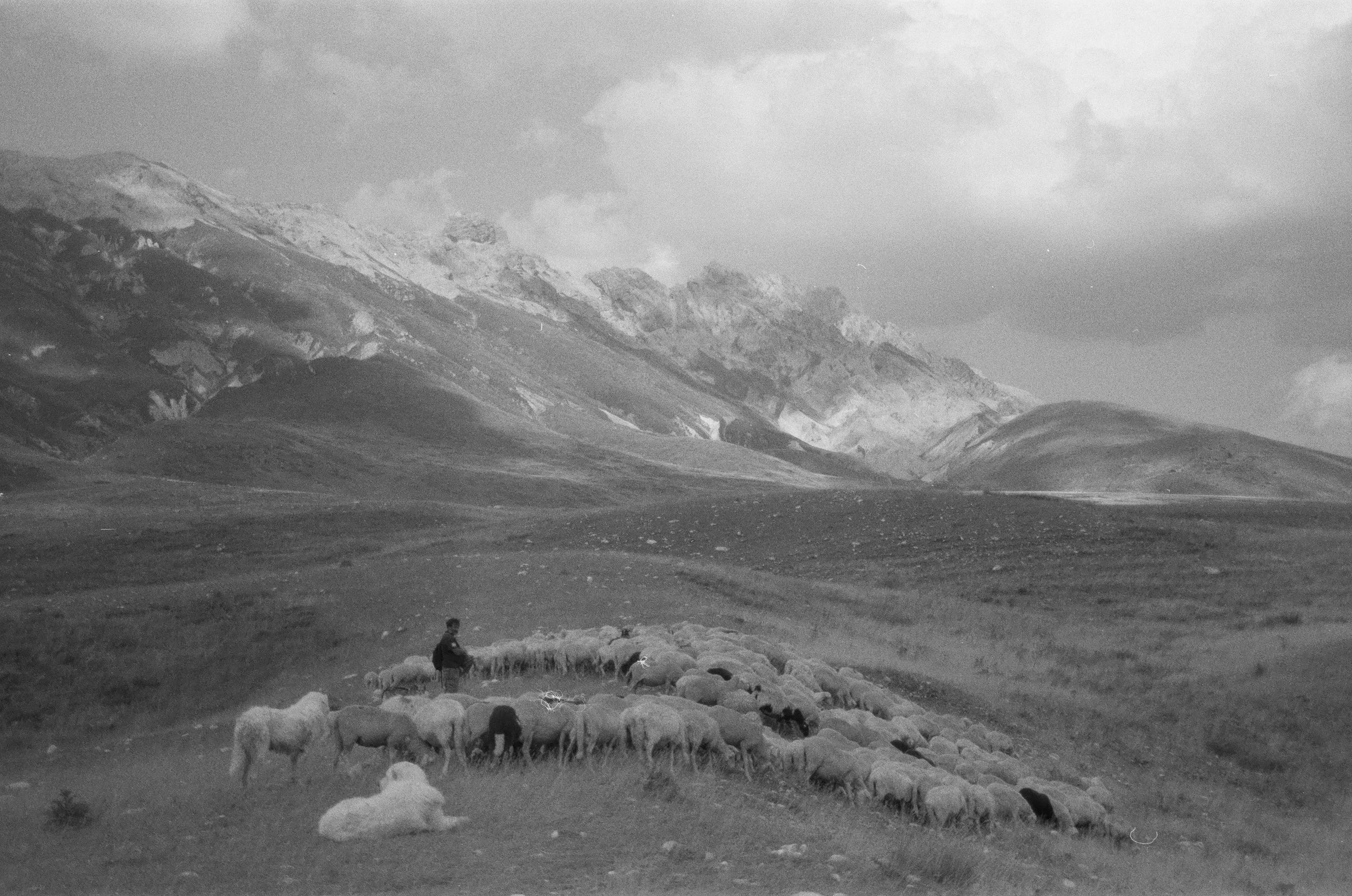
From the center of the lake one could see the many small towns perched all around it, rising above the shores, towns he knew well. The castle of Celano stood on the highest hill, and he would imagine, as a game, a young lady of the castle who from her window might spot him every morning there in the middle of the water.
One day he disobeyed his father and, instead of joining him in the boat with the other fishermen, he decided to take a small journey up to the castle—to feel, to understand what it looked like from up there, to change perspective. It was the first time he was no longer below, no longer looking into the dark, murky depths of the water, but instead seeing the whole landscape from above, and the lake seemed only a white reflection of light, just like a mirror.
Today, in his room, Liri returns to himself and takes a vase in his hands—a gift from his mother, who had received it in turn as a wedding present. The vase has a glossy black appearance, with dragon heads in relief on its outer surface.
“It is a magical vase,” his mother had said. “It is divinatory; it is used to read omens.”
The inside of the bowl is so dark that it seems deeper than it really is. Liri stares into that semblance of emptiness and remembers another moment, many years after his trip to the castle. He was standing in the very same place as when he was a boy; he had climbed up there to find shelter from the scorching sun.
The climate had changed. The humid air of the lake was now arid in summer, and winters were bitterly cold. The thin mist of dew that once formed on the water’s surface in the morning had been replaced by a cloud of dust hanging over the crater’s bed.
The lake was gone.
The Torlonia, now lords of the region, had managed to drain it. The inhabitants had been corrupted by the hope of money and the promise of stable land no longer subject to constant flooding. But in truth no one had expected such a change. No one imagined that beneath the water there was a marsh, and that once it too dried up there would be nothing. The land was barren, and the once-flourishing shores now looked like a hole in the landscape after a meteorite strike.
Liri heard that Torlonia was finding precious remains as the water receded. The lord was uncovering marbles, statues, and Roman bas-reliefs. He would take them and carry them away, saying that for the local peasants they would have no value anyway.
So Liri decided to gather some shards and fuse them together—not to sell them, but to take them away from him, and to carry with him that idea of ruin that Rome had been, and that his home had now become.
He takes the shelf—“the bottom of the lake”—and places it on the wall, at the center of the room, high up. Then he decides to dedicate himself to the last two things to do before departing again.
He lights a candle in remembrance, places a small white stone in the little bowl beside it as an offering, and prays to his ancestors. The Ember Tray is a small object he always carries with him, and that ritual is now the anchor between his old life and this new one as a wanderer.
Finally, he takes the small wooden table which, between its diagonal planks, had an opening below like a container, and realizes that inside there is a new book. Someone had left it there during his previous passage through the refuge.
The book is called Anaphora, and it tells a story he knows well: the story of a man who set out carrying only the essentials. That man left his roots, becoming a nomad, but along the journey he learned who he truly was—and that even while traveling, one’s home never truly leaves you; you carry it within yourself.
Home is not a place. It is what you carry with you.